Starter Maintenance: Feed, Store, Revive
Everything you need to keep your sourdough starter happy between bakes — feeding ratios, fridge routines for busy weeks, and how to bring a neglected starter back to life.
It’s fundamental that your starter is happy and active. Everything else follows from that. The good news: a starter is far tougher than it looks, and keeping it healthy takes about two minutes a day — or less.
The everyday feed: 1:1:1
A simple 1:1:1 ratio works well: equal weights of starter, fresh flour and water. For the Master Loaf, feed 50 g starter + 50 g flour + 50 g water. That gives you 150 g: 120 g for your dough and 30 g to keep for the next feeding.
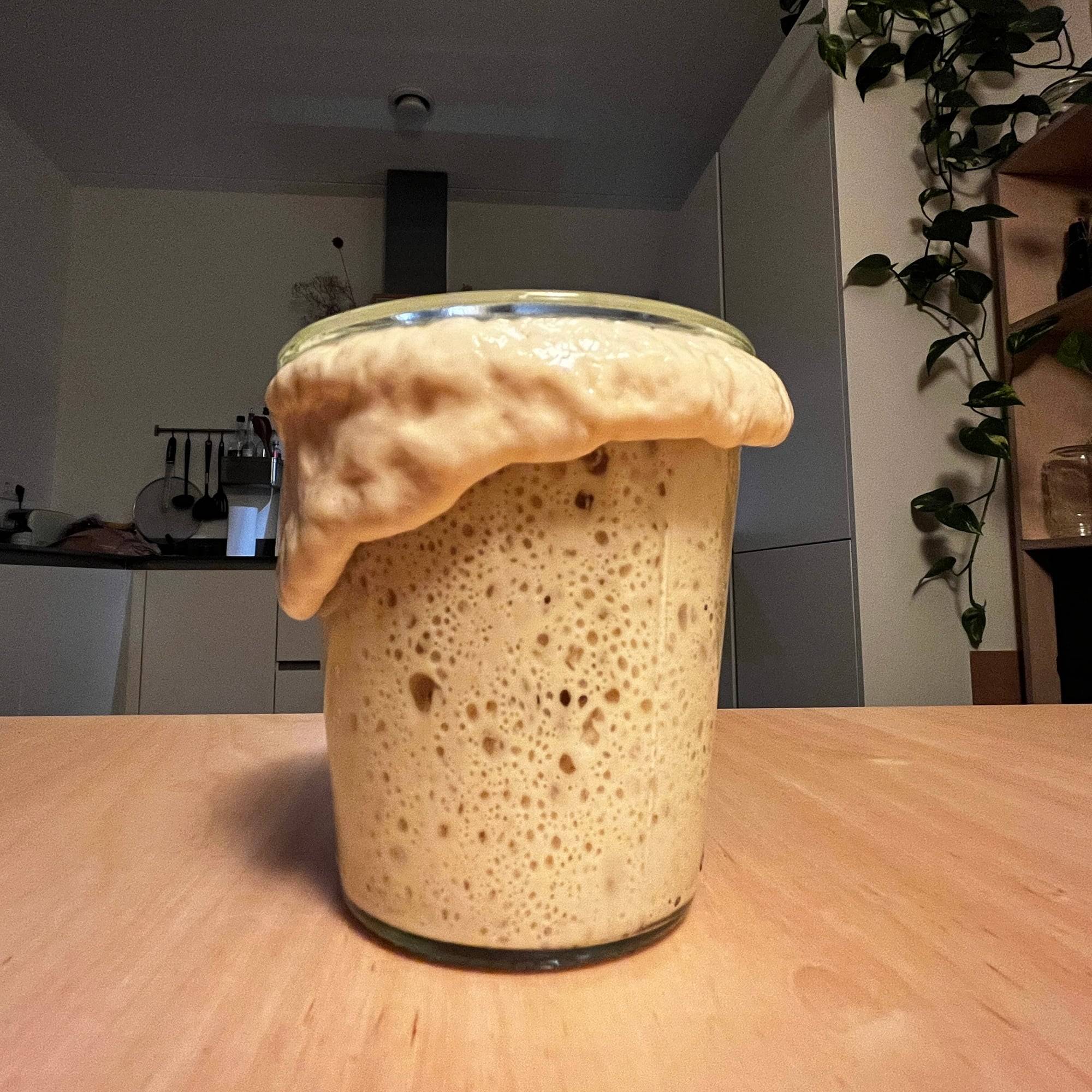
Use it at peak activity, when it has finished growing and the top is domed and bubbly. In a warm kitchen that’s usually 4 to 6 hours after feeding.
Is my starter ready to bake with?
- It smells yoghurty, slightly sour and tangy — not overly acidic or vinegary.
- It grows 2 to 3 times in volume after feeding.
- You’ve given it a few feedings in the days before baking, and it rises reliably every time.
Tip: put a rubber band around the jar at the level right after feeding. You’ll see exactly how much it grew.
If you bake 2+ times a week: keep it on the counter
Feed once or twice a day at room temperature. If your kitchen is warm (above 24°C) and it peaks too fast, use a stiffer ratio like 1:3:3 (10 g starter, 30 g flour, 30 g water) to slow it down.
If you bake once a week or less: keep it in the fridge
- After feeding, let it rise for 1–2 hours at room temperature.
- Put the lid on and move it to the fridge. It will happily wait a week.
- The day before baking, take it out and give it two feedings about 8–12 hours apart. Bake with it at peak after the second one.
Flour for feeding
Wholegrain wheat or rye makes a lively starter — the bran and germ are full of food for the microbes. A mix of 50% white and 50% wholegrain is a great everyday blend. Use spring or filtered water if your tap water is heavily chlorinated.
Reviving a neglected starter
A layer of grey liquid on top (“hooch”) just means it’s hungry. Pour it off, or stir it in for a tangier flavour.
- Discard all but about 10 g.
- Feed 1:5:5 with wholegrain flour (10 g starter, 50 g flour, 50 g water).
- Keep it somewhere warm (24–27°C) and repeat every 12 hours.
Most starters bounce back in 2–4 feedings. Only give up if you see pink, orange or fuzzy mould — then it’s time to start fresh.
Quick troubleshooting
| What you see | What it means | What to do |
|---|---|---|
| Barely rises | Too cold, or not enough feedings | Warmer spot, feed twice a day for a few days |
| Peaks and collapses fast | Too warm, or under-fed | Stiffer ratio (1:3:3), cooler water |
| Smells like nail polish | Very hungry | Feed more often, bigger ratio |
| Runny, no bubbles | Weak or too much water | Use a little less water, add wholegrain |
Want the whole method in one place?
Get the free Master Loaf guide: recipe, timelines, starter checks and a crumb diagnosis chart.