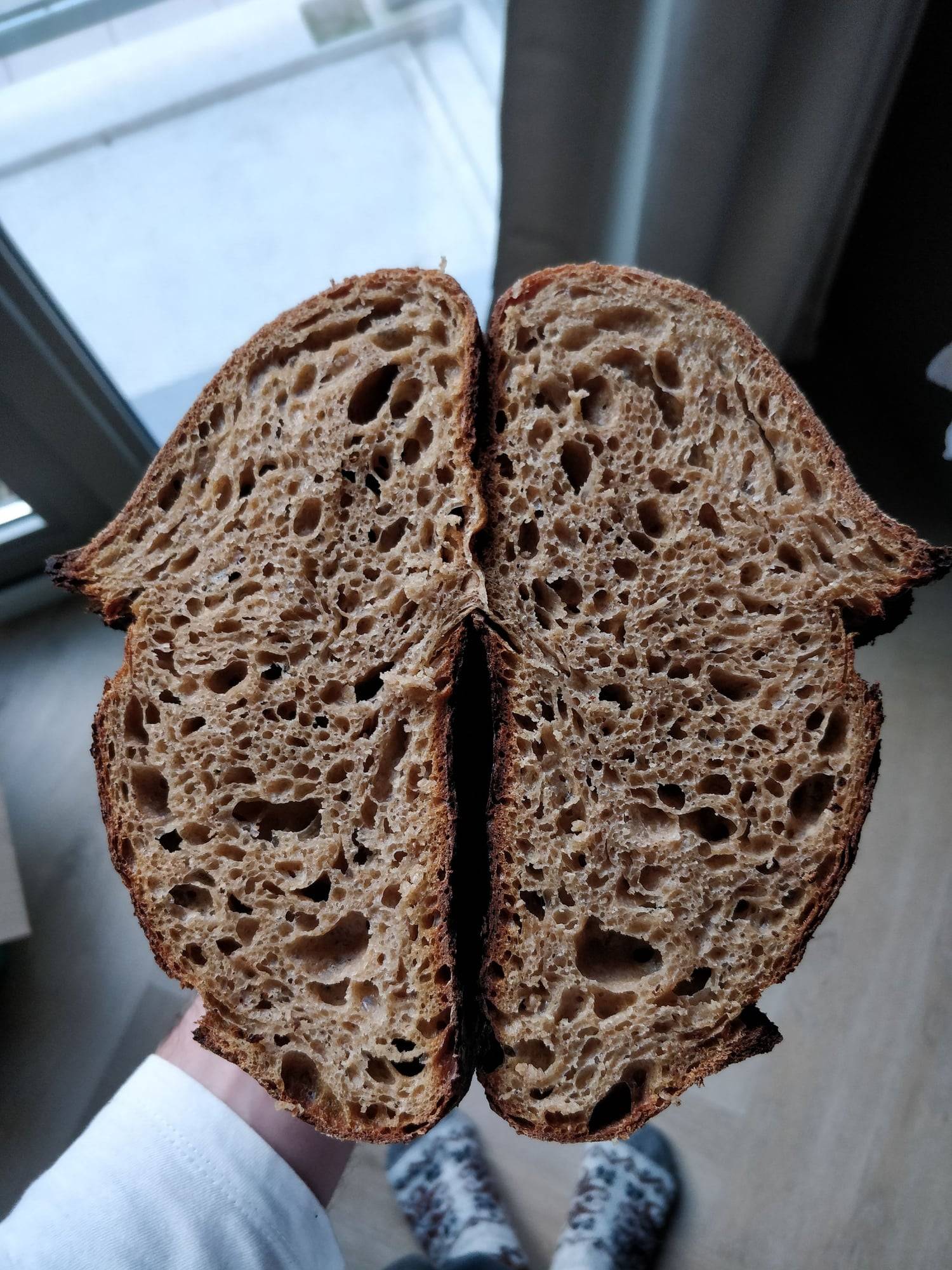
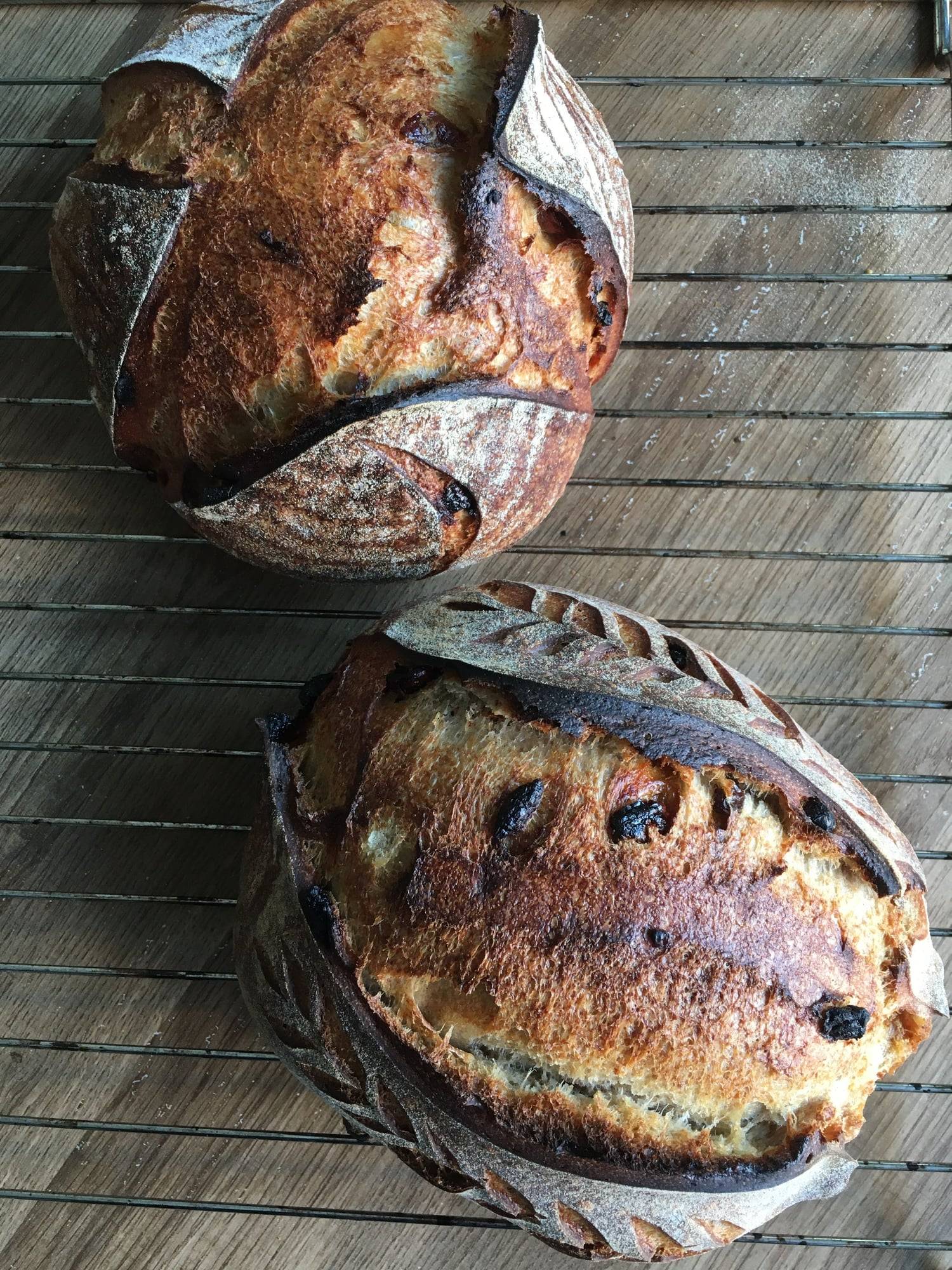
The Master Loaf
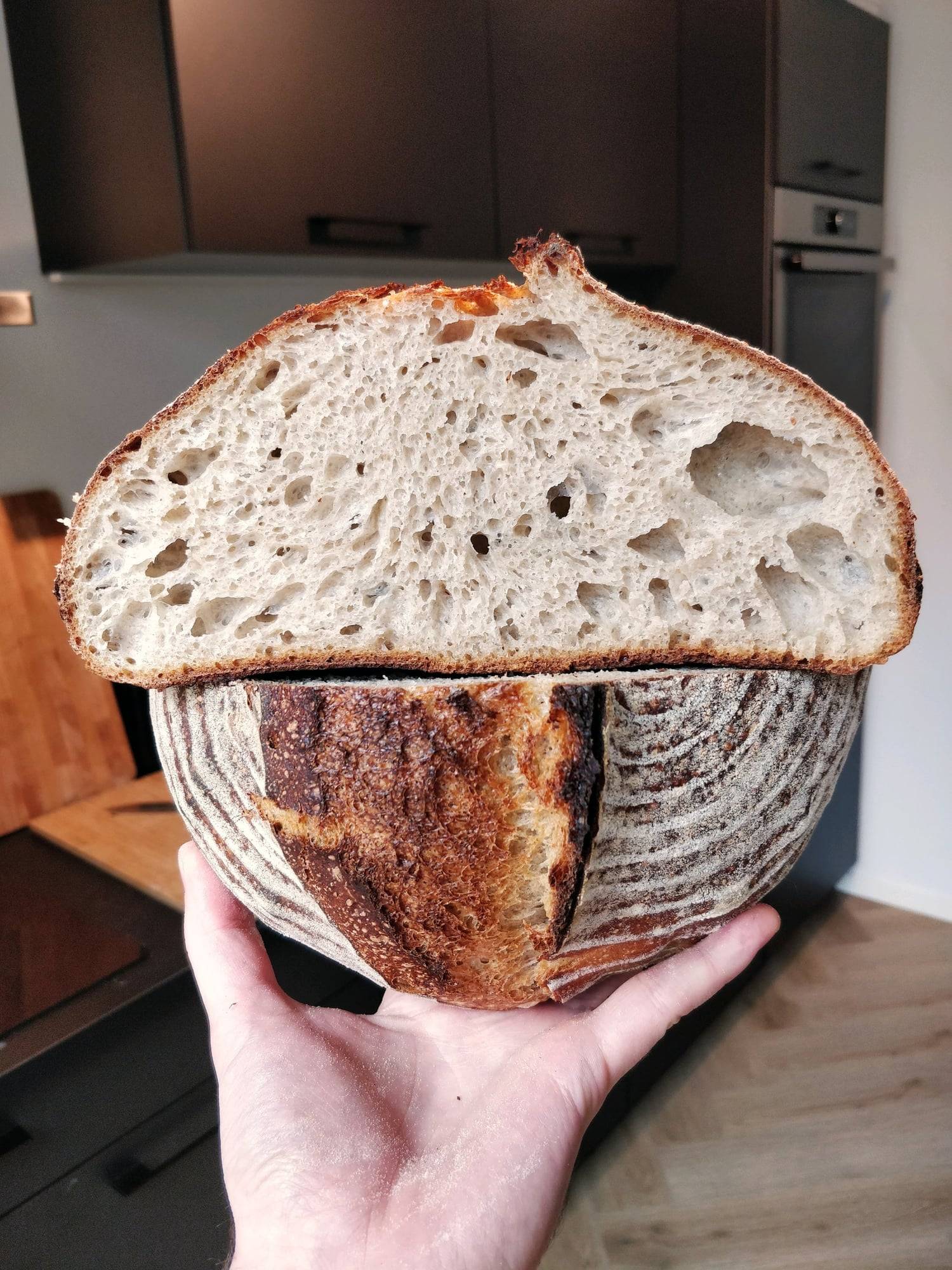
A country-style sourdough with a crunchy, golden crust and a soft, open crumb. The one everyday recipe you'll keep coming back to.
- Difficulty
- Beginner
- Total time
- ~20 hours
- Yield
- 1 loaf (~950 g dough)
- Hydration
- 71%
Method
- 1
Mix flour and waterRest 30 min
Add the water to the bowl first, then all the flour. Mix well until no dry flour remains — the handle of a wooden spoon works great. Cover and rest.
- 2
Add the starterRest 30 min
Add the starter, wet your hands and mix until no clumps remain. Bulk fermentation starts now. The ideal dough temperature is about 25°C. Good moment to feed your starter for next time.
- 3
Add the saltRest 30 min
Add the salt and mix again. If the dough feels stiff and hard to work with, add a little more water, 10 to 20 g.
- 4
StretchRest 30 min
From here on, be gentler. Stretch the dough as far as it will go without tearing — slap and fold, stretch and fold, coil folds or lamination all work.
- 5
Fold and build strengthEvery 30 min
Do a few more sets of stretches, then gentler folds as the dough rises. Finish with one tight ball of dough, as tight as it allows without tearing.
- 6
Finish the bulkAs needed
If needed, let the dough ferment a little longer. Well-fermented dough is light, bubbly and jiggles when you shake the bowl. Around 4 to 5 hours from adding the starter at 25°C.
- 7
Shape10 min
Flour the surface and the top of the dough, flip it out and gently spread into a square. Fold the left and right sides into the centre, then roll it up from top to bottom into a tight oval.
- 8
Cold proof12 hours
Place the dough seam-side up in a floured banneton, cover, and refrigerate on a middle shelf, not too close to the back wall.
- 9
Preheat1 hour
Next morning, put the Dutch oven in the oven and preheat to 250°C for about an hour.
- 10
Score
Turn the dough out onto baking paper. Score with a sharp blade held at about a 25° angle. The score guides how the loaf opens in the oven.
- 11
Bake~45 min
Lower the dough into the Dutch oven, close the lid and bake 25 minutes at 250°C. Remove the lid, lower to 230°C and bake another 18 to 20 minutes, until deep golden brown.
- 12
Cool1 hour+
Cool on a rack for at least an hour before slicing. The inside is still setting.
This is the no-brainer bread I bake all the time. A crunchy, golden-brown crust on the outside, soft and airy on the inside — proof that amazing things can be simple.
Baker’s percentages are relative to the total flour (490 g). Counting the flour and water inside the starter, overall hydration is about 71%.
An example schedule
| Time | Day 1 |
|---|---|
| 10:00 | Feed your starter |
| 14:00 | Mix flour and water |
| 14:30 | Add starter — bulk starts |
| 15:00 | Add salt |
| 15:30 | First stretch |
| 16:00–17:30 | Folds every 30 minutes |
| ~19:00 | Bulk done: shape, into the fridge |
| Time | Day 2 |
|---|---|
| 06:30 | Preheat oven and Dutch oven |
| 07:30 | Score and bake |
| 08:15 | Out of the oven. Cool, then slice |
Watch the dough, not the clock: a warmer kitchen means faster fermentation, a cooler one slower.
No Dutch oven? No problem
Preheat a pizza stone or heavy baking tray at 250°C with an empty metal tray on the rack below. Slide the loaf onto the stone, pour a cup of boiling water into the lower tray and close the door quickly. After 25 minutes, carefully remove the water tray and finish at 230°C until deep golden.
Didn't turn out the way you hoped?
Send me a photo of your crumb and I'll tell you exactly what to change next time.
Crumb Diagnosis →